Please read this cookie policy (“cookie policy”, "policy") carefully before using the perdata.com.au website (“website”, "service") operated by PerData Pty Ltd ("us", 'we", "our").
What are cookies?
Cookies are simple text files that are stored on your computer or mobile device by a website’s server. Each cookie is unique to your web browser. It will contain some anonymous information such as a unique identifier, website’s domain name, and some digits and numbers.
What types of cookies do we use?
Necessary cookies
Necessary cookies allow us to offer you the best possible experience when accessing and navigating through our website and using its features. For example, these cookies let us recognize that you have created an account and have logged into that account.
Functionality cookies
Functionality cookies let us operate the site in accordance with the choices you make. For example, we will recognize your username and remember how you customized the site during future visits.
Analytical cookies
These cookies enable us and third-party services to collect aggregated data for statistical purposes on how our visitors use the website. These cookies do not contain personal information such as names and email addresses and are used to help us improve your user experience of the website.
How to delete cookies?
If you want to restrict or block the cookies that are set by our website, you can do so through your browser setting. Alternatively, you can visit this Google page, which contains comprehensive information on how to do this on a wide variety of browsers and devices. You will find general information about cookies and details on how to delete cookies from your device.
Contacting us
If you have any questions about this policy or our use of cookies, please contact us.
This site uses cookies. Cookies help us deliver the best experience on our website.
Introducing PerData, formerly ITeMGroup A fresh take on decades long experience.
After over 20 years partnering with some of the most recognisable brands in Australia, we thought it was time to update our name and brand to better communicate how we make technology more bankable. We’re still independent, we’re financially strong, no contracts have changed, and our team remains completely consistent.
Where AI Value Actually Comes From, and It's Not Where You'd Think
Author : Timotius Devin
4 min read
August 11, 2026
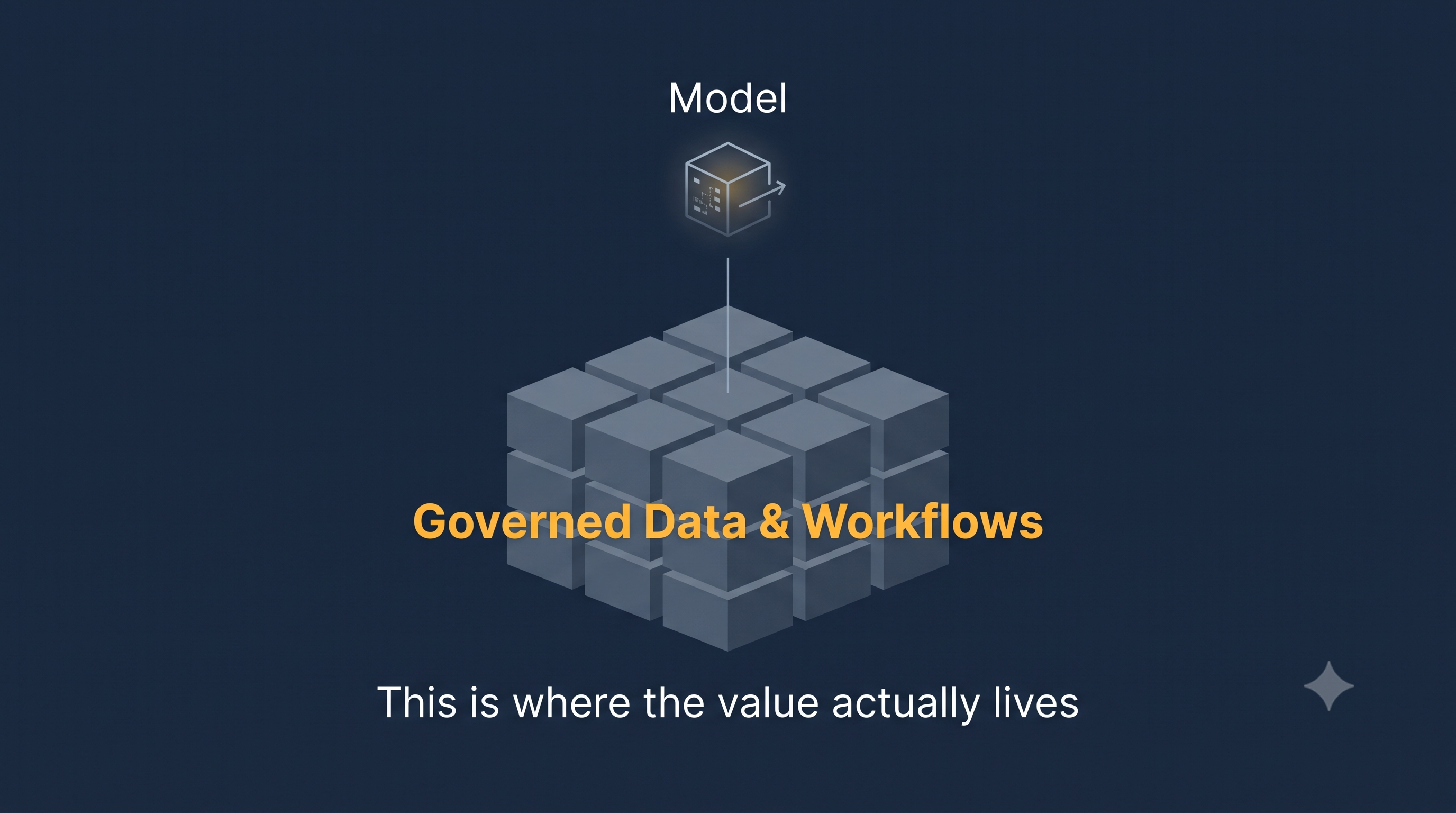
Ask most AI vendors where the value in an AI investment comes from, and you'll get the same answer: the model. Bigger, smarter, more capable, upgrade when the next one ships. Ask the organisations actually seeing real returns, and the answer is completely different.
The reveal
Microsoft's own Commercial CEO said as much last week, and it's a striking thing for a company that sells models to admit. Judson Althoff closed out Microsoft's FY26 with a reflection on what separates what Microsoft is calling "Frontier Firms" from everyone still stuck experimenting. His framing rests on two things: an intelligence platform where an organisation's own knowledge, data, and workflows compound over time, so value accrues to the customer rather than the model, and a trust platform pervasive enough to govern, secure, and measure AI across every business process [1].
Read that carefully and the claim is more specific than it first sounds. Value doesn'taccrue to the customer simply because AI got deployed. It accrues under a particular condition, an intelligence layer and a trust layer that belong to the organisation, not the vendor. Althoff didn't spell out what happens when that condition isn't met. That's the part worth sitting with.
What it actually requires
EY is the case study Microsoft points to, and the mechanism behind the result is more informative than the headline number. EY deployed Copilot to 150,000 employees and measured a 15% productivity gain, reinvested straight into client delivery and learning, and is now scaling to more than 400,000 employees globally through Microsoft's Frontier Suite [1].
The value there didn't come from the model. GPT-class models are available to any Microsoft customer with a licence. What EY had, and what most organisations chasing a similar result don't yet have, was a governed data and workflow foundation already built underneath the model. The model was the last piece added to something that already existed, not the thing that created the value on its own.
Where it doesn't show up
Here's where Microsoft's own framing gets complicated by evidence from outside Microsoft. An independent analysis of Microsoft's FY26 earnings call looked at several of the company's own showcase deployments, NHS England at 505,000 staff, KPMG at 276,000, HSBC at 200,000 seats, EY at 400,000, and drew a sharp distinction most coverage skipped past: these figures demonstrate procurement depth, not work completed or capacity actually released [2]. An organisation can report tens of thousands of licensed seats and monthly active users and still be unable to price the actual benefit, because nobody has identified which workflows the tool is meant to touch.
That gap isn't unique to Microsoft's marquee clients. It's the same pattern showing up across the broader market. SAP's Value of AI Report 2026 found 42% of Australian businesses admit they're deploying AI agents faster than they can standardise or govern them [3]. Deloitte's most recent research found only 28% of Australian organisations have moved at least 40% of their AI pilots into production [4]. Different data sets, same underlying story: deployment and value are not the same event, and a lot of organisations are currently paying for the first while assuming they've achieved the second.
The test worth actually running
If value only accrues under a specific condition, it's worth being able to check whether your own organisation meets it. Here's a genuinely useful question: if your AI provider changed tomorrow, would your organisation's advantage move with your data, or disappear along with the model?
For most organisations today, the honest answer is somewhere between "not sure" and "it would disappear." Recent independent analysis of the enterprise AI vendor landscape frames this as a trust-versus-lock-in trade-off, and makes the point plainly: model choice is only one layer of a much bigger architecture decision, and the deeper risk usually sits in the data and workflow layers underneath it, not the model itself [5]. A model can be swapped in an afternoon if the layer underneath it is genuinely yours. If it isn't, swapping the model means rebuilding the whole thing.
The reframe
None of this means Microsoft's framing is wrong, "value accrues to the customer, not the model" is a genuinely correct principle. What's missing is the condition attached to it. That value only accrues if there's something durable underneath the model that belongs to the organisation, not the vendor, governed, structured, and built before the model ever gets chosen.
If you're not sure whether your organisation currently meets that condition, that's precisely the honest starting question. Not "which model should we use," but "if we swapped models tomorrow, what exactly would we lose." PerData works with Australian mid-market organisations to answer that question properly, starting with an honest look at the data foundation underneath the AI, not a demo of what's technically possible. That's exactly what an AI Readiness Assessment is for.