Please read this cookie policy (“cookie policy”, "policy") carefully before using the perdata.com.au website (“website”, "service") operated by PerData Pty Ltd ("us", 'we", "our").
What are cookies?
Cookies are simple text files that are stored on your computer or mobile device by a website’s server. Each cookie is unique to your web browser. It will contain some anonymous information such as a unique identifier, website’s domain name, and some digits and numbers.
What types of cookies do we use?
Necessary cookies
Necessary cookies allow us to offer you the best possible experience when accessing and navigating through our website and using its features. For example, these cookies let us recognize that you have created an account and have logged into that account.
Functionality cookies
Functionality cookies let us operate the site in accordance with the choices you make. For example, we will recognize your username and remember how you customized the site during future visits.
Analytical cookies
These cookies enable us and third-party services to collect aggregated data for statistical purposes on how our visitors use the website. These cookies do not contain personal information such as names and email addresses and are used to help us improve your user experience of the website.
How to delete cookies?
If you want to restrict or block the cookies that are set by our website, you can do so through your browser setting. Alternatively, you can visit this Google page, which contains comprehensive information on how to do this on a wide variety of browsers and devices. You will find general information about cookies and details on how to delete cookies from your device.
Contacting us
If you have any questions about this policy or our use of cookies, please contact us.
This site uses cookies. Cookies help us deliver the best experience on our website.
Introducing PerData, formerly ITeMGroup A fresh take on decades long experience.
After over 20 years partnering with some of the most recognisable brands in Australia, we thought it was time to update our name and brand to better communicate how we make technology more bankable. We’re still independent, we’re financially strong, no contracts have changed, and our team remains completely consistent.
Your AI Agent Can Read Your Data. Can It Also Leak It?
Author : Timotius Devin
4 min read
October 07, 2026
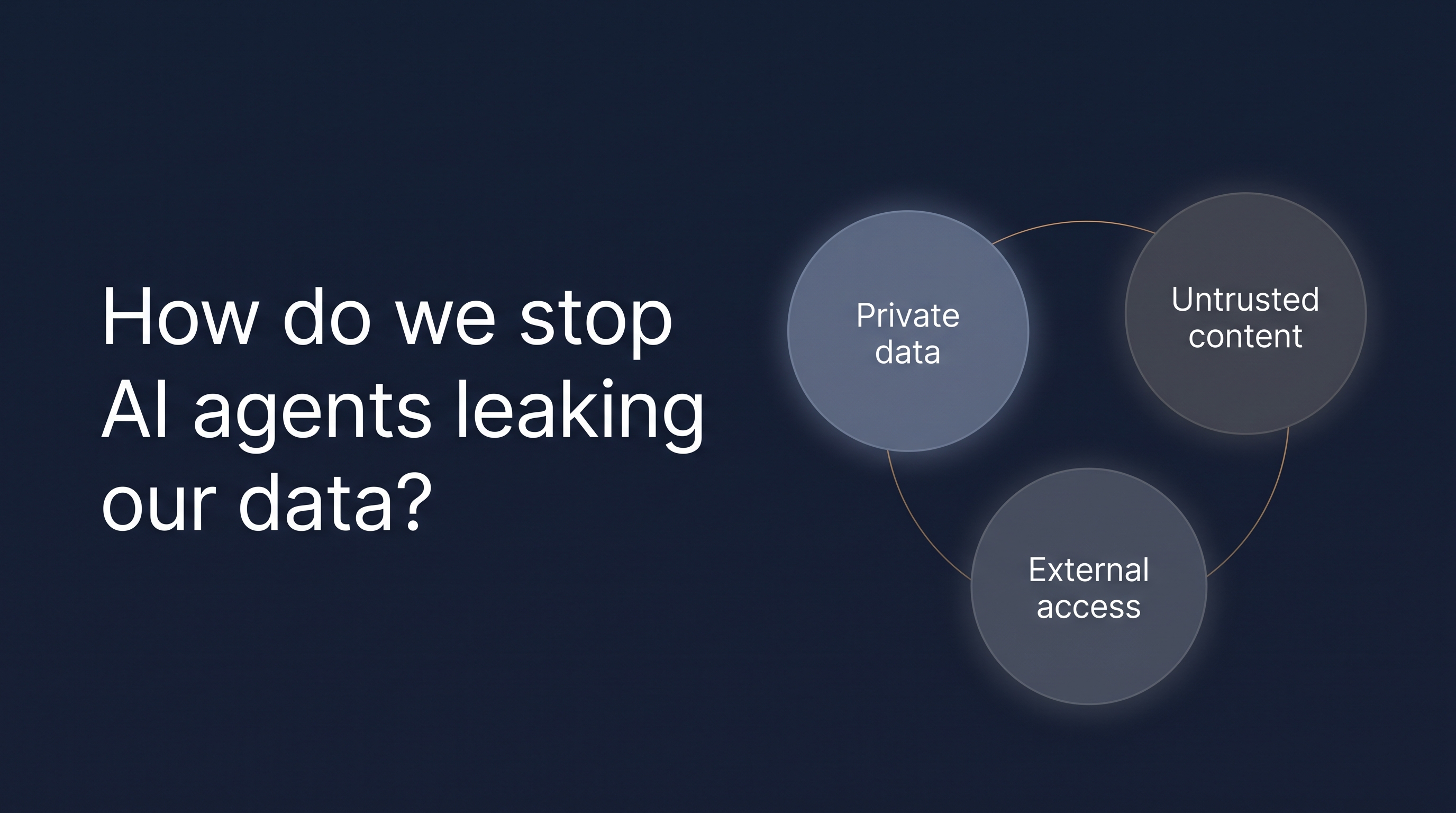
Most AI agent data leaks happen when one agent combines three things: access to private data, exposure to content you don't control, and a way to send information outside your organisation. Remove or tightly control any one of those three, and the most common leak path closes.
Why this matters now
In April 2026, the Cloud Security Alliance and Token Security reported that 65% of organisations had experienced at least one cybersecurity incident caused by AI agents in the past year. Of those, 61% involved sensitive data exposure. The same research found that 60% of organisations couldn't terminate a misbehaving agent, and 67% lacked audit trails across all the data channels their agents could reach.
Most of that data comes from the US, where agent adoption is further along. That gives Australian organisations a useful advantage: the chance to learn from these incidents before our own agents reach the same scale.
The pattern behind most leaks
OWASP's 2026 reporting found prompt injection is still the main cause of agent security failures in production. The reason is structural. A language model can't reliably tell the difference between an instruction from you and an instruction hidden inside an email, a document or a web page it has been asked to read.
That's why security researchers talk about a "lethal trifecta". An agent that can read private data, process untrusted content, and communicate externally can be turned into an exfiltration tool by a single well-placed piece of text.
Real incidents often start somewhere less dramatic. In April 2026, Vercel disclosed a breach in which attackers compromised a third-party AI tool that an employee had connected with OAuth access, then used that access to move into Vercel's systems.
What to do about it
The practical controls are mostly about design, not products:
Give every agent its own identity with the least access it needs. On Microsoft, that means managed identities and Entra rather than shared keys.
Separate the agents that read untrusted content from the agents that touch sensitive data, wherever you can.
Put an AI gateway between agents and models, so every call is authenticated, logged and rate-limited. We wrote about why this layer matters in We Nearly Shipped the Wrong AI Architecture.
Require a human approval step before an agent sends data outside the organisation.
Make sure you can switch an agent off, and that you can see what it touched.
FAQ
What is prompt injection? It's when text inside content an AI reads, such as an email or document, is interpreted as an instruction. The model follows it because it can't reliably distinguish data from commands.
Is Microsoft 365 Copilot affected by this? Any AI that reads content is exposed to some degree. Copilot only surfaces data a user can already access, which limits the damage, but permissions still need to be right.
Does the Privacy Act cover AI agents? If an agent uses personal information to make, or substantially help make, decisions that significantly affect people, new transparency obligations apply from 10 December 2026.
Planning your first production agent? Our AI Readiness Assessment reviews identity, network and gateway design before anything goes live.
About the author:Timotius Devin is AI Lead at PerData Technology Partners in Melbourne. At PerData Devin helps Australian organisations design, govern and deploy AI on the Microsoft platform.
Sources
Kiteworks, citing Cloud Security Alliance and Token Security, AI Agent Security Incidents Hit 65% of Firms in 2026: https://www.kiteworks.com/cybersecurity-risk-management/ai-agent-security-incidents-2026/
Help Net Security, Prompt injection still drives most agentic AI security failures in production (OWASP): https://www.helpnetsecurity.com/2026/06/11/owasp-prompt-injection-ai-security-failures/
Rapid and rigorous project process to make your project startable.
Rapid and rigorous project process to make your project sustainable