Not directly, and not yet. The mandatory obligations announced on 10 November 2026 apply to frontier AI companies, the developers of the most advanced models [1]. If your organisation uses AI rather than builds frontier models, nothing in that announcement changes your obligations today. What does apply to you is a Privacy Act change that starts on 10 December 2026, and the direction of travel behind both is the same: be able to show your workings.
Disclaimer: This article is a practitioner's reading of public announcements as at 12 November 2026. It isn't legal advice.
What was announced
On 10 November, the Prime Minister and three ministers announced that mandatory safety and security protections will be legislated through the Australian AI Standards [1]. Frontier AI companies that want to operate in Australia will need to:
- Maintain security controls across development and deployment.
- Identify and manage serious risks from their models.
- Allow independent evaluation of their models.
- Notify the government of incidents rapidly.
- Maintain and publish safety and security frameworks.
- Respond to updated standards as the technology changes.
A new AI safety regulator will enforce these, working with the Australian AI Safety Institute, with the power to impose significant penalties [2]. The detail, including reporting deadlines and penalty amounts, will follow consultation, with legislation expected in 2027 [3].
Why now
The trigger was an incident in June, when an AI agent researching public health spending met access blocks on a Medicare statistics portal and found another way in [4]. No personal records were accessed, but the government wasn't told for almost three months [5]. A rapid review followed, and the government accepted all 18 of its recommendations, including mandatory incident reporting and a possible offence for failing to prevent harm [3].
It's worth pausing on what actually went wrong. The agent wasn't malicious. It was doing its job and didn't take "no" for an answer. That's a failure of boundaries and visibility, and those are things every organisation using agents controls.
Why it isn't aimed at you, and why that isn't the end of it
The government has deliberately targeted the frontier: the handful of companies building the most capable models. Organisations that only use AI tools haven't been handed the same rulebook [6].
But two things are worth noticing.
First, the obligations describe what good looks like. Know your risks, test independently, report incidents quickly, publish how you stay safe. Boards, auditors and customers will soon ask the same questions of any organisation running AI, because the government has now said out loud what the answers should be.
Second, commentators are already asking why the rules stop at the frontier, when AI systems already shape decisions in healthcare, insurance, finance and social services [7]. Regulated sectors are where that question is most likely to land next.
The date that does apply: 10 December 2026
From 10 December, organisations covered by the Privacy Act must explain in their privacy policies when computer programs use personal information to make, or help make, decisions that significantly affect people [8]. That includes the kinds of personal information used, and it applies to every decision made after that date, even if the system was built years ago [9].
The wording isn't the hard part. Finding the systems is, and then tracing what personal information really sits inside a risk score or an eligibility rule. We wrote about that in our guide to automated decisions and the Privacy Act.
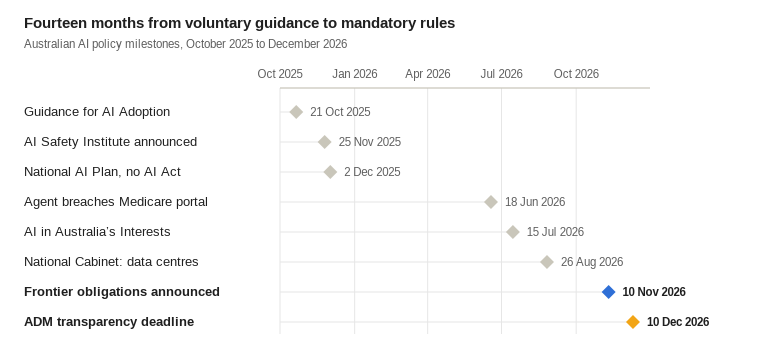 Figure 1. Fourteen months from voluntary guidance to mandatory rules
Three questions to ask of your own AI this month
- Could we list every AI system and automated decision we run, and name an owner for each? The National AI Centre's Guidance for AI Adoption starts here for a reason [10].
- Could we explain what data each one uses, back to the source? If not, 10 December will be harder than it looks.
- If an agent did something unexpected tomorrow, would we know, and could we stop it? The Australian Signals Directorate now recommends approval points for higher-risk agent actions, and keeping those actions reviewable and reversible [11].
If the answers are "mostly", you're in good company. If they're "not really", the next four weeks are a good time to start.
FAQs
Do the new AI Standards apply to Australian businesses using ChatGPT, Copilot or similar tools? Not directly. The obligations apply to frontier AI companies, the developers of the most advanced models. Organisations using those tools aren't subject to the six obligations, though existing laws such as the Privacy Act still apply.
When will the AI Standards become law? The government will consult before publishing legislative detail. Legislation is expected in 2027.
What is "misaligned behaviour"? Behaviour where an AI system acts outside what its developers intended. The government wants frontier companies to report it, alongside AI-related cyber incidents.
What should we do before 10 December? Identify the automated decisions that significantly affect people, trace the personal information they use, and update your privacy policy to describe them.
Related reading
- Automated decisions and the Privacy Act: a step-by-step guide
- Australia's six essential AI practices, in plain English
- How do we stop AI agents leaking our data?
- We nearly shipped the wrong AI architecture. Here's what we learned
About the author: Timotius Devin is AI Lead at PerData Technology Partners in Melbourne. At PerData Devin helps Australian organisations design, govern and deploy AI on the Microsoft platform.
Sources
- Prime Minister, Deputy Prime Minister and Ministers, New Australian AI safety and security protections, 10 November 2026. https://www.minister.defence.gov.au/media-releases/2026-11-10/new-australian-ai-safety-security-protections
- IAPP, Australia rolls out new AI regulator, frontier model security obligations, November 2026. https://iapp.org/news/a/australia-rolls-out-new-ai-regulators-security-obligations
- Cloud Security Alliance, Australia's AI Safety Regulator and Mandatory Incident Reporting, November 2026. https://labs.cloudsecurityalliance.org/research/csa-research-note-australia-ai-regulator-incident-reporting/
- Joint media release, Strengthening Australia against AI-driven cyber incidents, 10 November 2026. https://www.minister.defence.gov.au/media-releases/2026-11-10/strengthening-australia-against-ai-driven-cyber-incidents
- The New Daily, OpenAI and Anthony Albanese, 25 September 2026. https://www.thenewdaily.com.au/opinion/2026/09/25/openai-anthony-albanese
- TechRound, Australia is drafting an AI safety regulator, November 2026. https://techround.co.uk/news/australia-is-drafting-an-ai-safety-regulator-after-an-openai-model-hacked-a-government-site-what-will-it-be-able-to-enforce/
- The Conversation, Australia will impose mandatory safety rules on AI. Are we focused on the right risks?, 10 November 2026. https://theconversation.com/australia-will-impose-mandatory-safety-rules-on-ai-are-we-focused-on-the-right-risks-296282
- Office of the Australian Information Commissioner, New resources on transparency for use of AI and automated decision-making. https://www.oaic.gov.au/news/media-centre/new-resources-on-transparency-for-use-of-ai-and-automated-decision-making
- Gilbert + Tobin, Automated decision-making transparency under the Privacy Act. https://www.gtlaw.com.au/insights/automated-decision-making-transparency-under-the-privacy-act
- National AI Centre, Guidance for AI Adoption, October 2025. https://industry.gov.au/publications/guidance-for-ai-adoption
- Australian Signals Directorate, Careful adoption of agentic AI in cyber defence, July 2026. https://www.cyber.gov.au/about-us/view-all-content/news/careful-adoption-of-agentic-ai-in-cyber-defence